Design Thinking Facilitation Skills Training
Design Thinking Facilitation Skills Training Are you interested in how design thinking could be used to help support your social entrepreneurs or your work as part of UnLtd? If so this course might be for you… Main body of text Following good feedback from the application process review design led methodologies and design sessions with social entrepreneurs as part of the Transform Ageing programme I wondered if anyone else would be interested in doing a couple of training sessions on design thinking? One of the consultants from Transform Ageing, Jonathan Ball, has offered to run a course for 16 of us over late Feb-early Feb. The 2-day course would:- Be 2 singular days a 2-3 weeks apart
- Most likely in London, but could be in Birmingham or Bradford depending on those interested
- The things to expect to come away with are:
- A toolkit of methods, resources, and frameworks for design-led innovation
- An understanding of how you build a design process through “setting up the session”, “ideation” to “implementation”
- Learn how to run key sessions like customer journey mapping, understanding your beneficiaries, purpose primers, values and mission statement creation, group workshops exploring a specific sector need etc.
- On the course you’ll be split into 4 groups of 4 people. Probably 3 teams of award managers and venture managers and 1 team of “central” staff.
Pecan Pantry SIM workbook (1)
“We help X do Y by doing Z”. For ____________ (target customer) who ____________ (statement of the need or opportunity) our (product/service name) is ____________ (product category) that (statement of benefit) ____________ . “People don’t buy what you do; people buy why you do it.” – Simon Sinek, Golden Circle Framework Apple: “(Why) We believe in challenging the status quo and doing things differently. (How) Our products are beautifully designed and easy to use. (What) We make computers.” Why: ___________ How: ___________ What: ___________| Questions for the VP Statement | Details from the social enterprise | |
|---|---|---|
| Customer | What benefits do your customers want? What do they currently like about other solutions they access? | |
| Customer | What are your customers trying to achieve? | |
| Customer | What are the pains your customers/beneficiaries want to avoid? | |
| Value map | What does your product or service help customers/beneficiaries achieve? | |
| Value map | How does your product or service deliver gains to customers/beneficiaries? | |
| Value map | How does your product or service fix the pains to customers/beneficiaries? |
| Indicator | Method | Milestone | Target | When will data be collected? | How long will it take? | Who is responsible? | Cost |
|---|---|---|---|---|---|---|---|
Sales and BD Project - Moments Cafe - Customer Journey Mapping
Sales and Business Development Portfolio Project – Moments Café and UnLtd It was established through due diligence, pitching and support that Moments Cafe would like to access support around developing their sales approach and business development portfolio for the Moments Café. As such Tim Lages, Sam Alford and Kate Smith will work together through the following process:- Session 1 – Kick Off – Jan 29th
- Develop a “How Might We” statement and define the vision for the project
- Establish what materials we already have
- How these materials are currently used
- Identify the customer journey and what the customer is doing, thinking, feeling and experiencing
- Session 2 – Stakeholder Mapping – Feb 13th
- Develop personas of 5 potential, typical, customers
- Keeping in mind sentiment of the customer, buying power, motivation, buy in etc
- Session 3 – Prototyping – Feb 15th
- Using the knowledge gained from session 1 and 2 we’ll prototype what resources we want to create for each stage of the process
- Build phase – End of march
- Build new resources
- Adapt existing resources
- Establish new resources
- Create a test and learn approach
- Delivery and testing (beyond lifetime of support) – April onwards **Session 1 – Kick Off – Jan 29th **
- Traditional marketing approaches and resources – prominently used at the start of the process (“pre-interest” and “interest”)
- Market knowledge
- Sector support and relationships
- Business systems and process
- Demonstrating the why?
- Sales approach
- Impact data (used throughout the process but not to it’s full effect)
- Pre-interest:
- Thorns
- Time it takes to research interest
- Is the process to passive at the start?
- Buds
- Lots of resources + mechanisms to generate interest - SOMETHING STREAM?
- Roses
- Getting in front of the right people to share ideas
- Showcasing what we have
- Interest
- Thorns
- Putting Kate’s knowledge into a system (emptying the brain)
- Social impact packaging
- Pull together “whys” with evidence! Less searching
- Do we know yet what the optimum journey to sign-up meet be?
- Buds
- Need to learn how to pre-empt customer questions and not leave them feeling confused and un-empowered/demotivated
- Roses
- Collecting lots of useable data
- Getting to the customer to ask the right questions
- Sign Up
- Thorns
- Information sharing seems disjointed rather than planned
- No idea of likely timeframes to convert to sign up
- Buds
- Roses
- Do
- Thorns
- Buds
- Roses
- Come Back
- Thorns
- Utilise support better
- Buds
- Roses
- Overarching
- Thorns
- Lack of stakeholder nurturing due to busyness
- Not enough directionality in current approaches
- Buds
- Delegations can be done better
- Empowering the team to do more
- Ability to shape what we have against customer needs
- Need to incorporate qualifying leads tool in sales process
- Need to utilise the board
- Create versatile reports that use current assets and relate them to customer specific health data
- Roses
- We have 90% of what we need
- No how to help and have a proven delivery model backed up by research Key insights and questions to ask ourselves
- It’s about adapting the majority of the existing tools and using them in the right way
- Creating a versatile report to demonstrate impact data against area specific health data
- Delegation to the team and how this can best utilise resources against the current pipeline
- Evidence of investment is important (“starred” point)
- Service Design Agreement – we are the best this is our process (“starred” point)
- Sales tactics and making the customer ask the right question e.g. “what difference will this make for us?” Not “is this for us””
- Need to spend time mapping out contractual arrangements
Values and Mission Design Session
Find Your Voice – Values and Mission Design Session – 19.08.19 Time: 10/10.15 for a 10.30 start. Should take about 3-3.5 hours. Aim: Create a set of company values and mission statement that can be used internally and externally Brief: run a design session to fulfil the aim with the findings from the day being owned by FYV and incorporated into all future work and publications Equipment required: Large sticky notes (2 colours), 2 x 4 packs of dif colour post it notes, 6 black sharpies, flipchart paper and masking tape Session Design:- Intro to design and the purpose of values and mission statements – 5 mins
- Activity 1: Quick exercise reviewing other companies mission statements + vision – 10 mins
- Activity 2: pitching (with other listening noting down keywords/phrases that are clearly integral to how FYV feels) – 15 mins
- Activity 3: Exercises to help up come up with the values we need – 1 hour
- When were we most FYV?
- How much are we these values? (dotmocracy?)
- How might we emphasise these?
- What does that look like and why are they important?
- What do we need for the future?
- Break – 15 mins
- Recap by clustering together what we’ve already got – 10 mins
- Activity 4: Creating a mission statement (+another to do the vision) (20:20 exercise by Hyper Island) – 25 mins
- Re-cluster ideas around the mission statements and set out objective of making a “values tree” – 5 mins
- Review netflix’s values: https://www.slideshare.net/reed2001/culture-1798664 and discuss how FYV could map out their objectives in a similar fashion - 20 mins
- Create a values tree – 40 mins
- Close or create a design square to test what we’ve done – 20 mins
- Other SEs values/mission:
- Tom’s shoes
- Hackney pirates
- Oomph
- Recommendation 1
- Recommendation 2
- Mission = how you are going to contribute to the vision
- Vision = the change you want to see in the world
- Values = qualities of that the business and individuals near to see for the vision and mission to be achieved
1 Design Resouce Guide
Design Resource Guide Created by Tim Lages Last updated October 2019 By Tim Lages Purpose/overview** of the guide** Act as a directory and offer a brief description for the design workshops that VMs can run with their SEs. This should be a living document and resources referenced and explained in the format below. Please try to include examples of completed sessions where possible and include clear instructions so others can use your work. Resources available- Designing the session Designing the session can be a daunting process but many design agencies share their resources and most SEs have a challenge in mind they want to solve. “1A”, “1B” and the rest of this document offer some handy workshop designs/principles to follow to create your session(s). Between these available ideas and the challenge you are trying to solve you can normally choose something that is suitable. Whilst the main activity you run through may for example be a “customer journey map” it’s often important to frame the purpose of the session, have a method of incorporating users or testing the approach and having a way to end the design work with actions and outputs (closing the session).
- Hyper Island Toolbox A resource kit you can use to apply creative collaboration and unleash potential in your team or organisation. Hyper Island categorises its toolkit into five categories: Move the room with energizers - Tools to inject energy into the process, get people moving, and have fun. / unlock insight and innovation - Tools to unleash creativity, discover valuable insights, and develop new products and services. /grow your self-leadership - Tools for personal development, reflection, self-awareness and how to integrate learning and grow. / make change through action - Tools focused on implementation and driving and supporting change in organizations. / build a strong team Resource:
- IDEO Design Kit Think of these methods as a step-by-step guide to unleashing your creativity, putting the people you serve at the centre of your design process to come up with new answers to difficult problems. IDEA split the guides into various sections that can either be filtered by question e.g. How do I conduct an interview? Or by stage e.g. “inspiration” “ideation” “implementation” Resource:
- Framing the purpose of the session (Inspiration) When beginning any design process it’s essentially to know what you are trying to achieve. Are you wanting to create a product with X in mind? Do you want to overcome a wicked problem? Is there a challenge amongst the team you can’t quite get to grips with? In this section we’ll discuss two tools you could use to discuss the focus of the design work in first instance.
- Purpose Primer – Design Squares The purpose primer is a great way of hosting lots of different ambitions for the session in one place. Offering an opportunity for everyone to contribute their thoughts and focus around a single ambition. The central box should always be the ambition and is the place you kick off with. Broadly try to define what the ambition is before beginning with any of the other boxes (it’s not the final version so you can change it going forwards). Then you can move to the outer boxes, these boxes can be called anything but the 4 suggested are a handy place to begin. “Vision” is context in which you want the ambition to be achieved, along with, potentially, some of the “how’s”. “Impact” – what will undertaking/completing this work achieve? “Challenges” is pretty self-explanatory as is the “people” section just remember to include those you are impacting, staff members and any other stakeholder involved. The people section could also include other organisations, businesses or groups. Resource: “2a Purpose Primer - Design Square” (includes an example from a social entrepreneur who wanted to increase uptake of his service. 2 photos are included and demonstrate how the purpose primer can develop over time)
- How Might We… Every problem is an opportunity for design. By framing your challenge as a How Might We question, you’ll set yourself up for an innovative solution. We use the How Might We format because it suggests that a solution is possible and because they offer you the chance to answer them in a variety of ways. A properly framed How Might We doesn’t suggest a solution but gives you the perfect frame for innovative thinking. UnLtd have used it internal projects such as the application process review and when supporting ventures to frame problems that need innovative ideas e.g. income generation, user engagement etc. Resource:
- Testing Resources (ideation)
- Nonon Sketch sheets When you have some ideas in mind about what you want to create then these worksheets can be a handy way of recording ideas. They provide different settings for ideas to be mapped out, recorded and given brief descriptions. They can be used in any stage of the process and are things to keep checking back in on. Resource “3a Nonon_SketchSheets_A4”
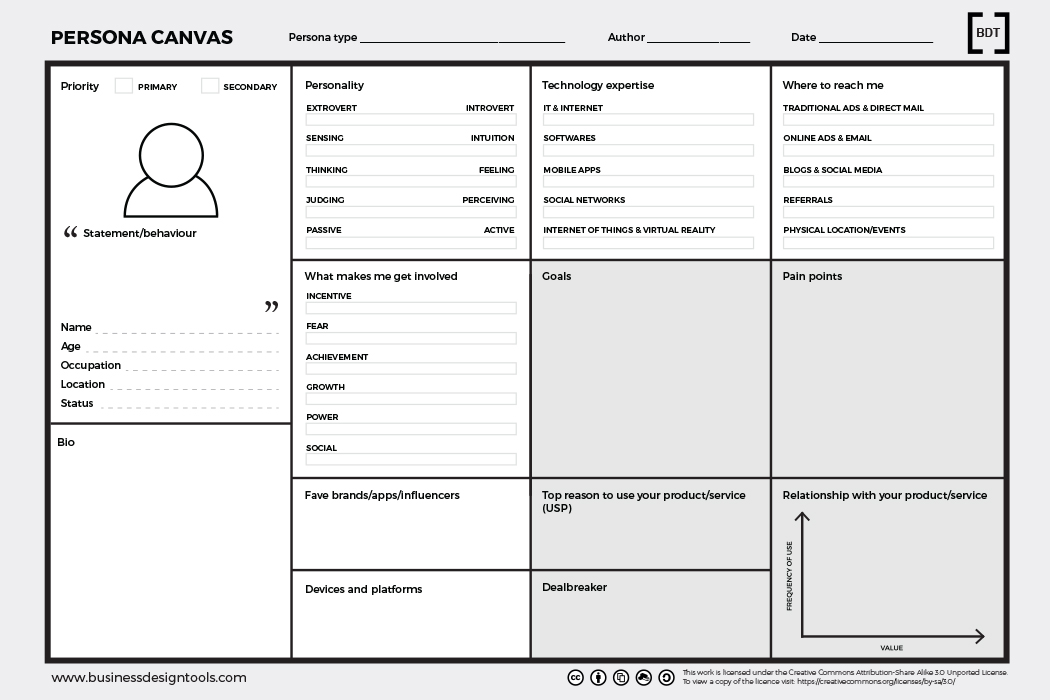
- Personas Worksheet Personas are fictional characters, which you create based upon your research in order to represent the different user types that might use your service, product, site, or brand in a similar way. Creating personas will help you to understand your users’ needs, experiences, behaviours and goals. Creating personas can help you step out of yourself. It can help you to recognise that different people have different needs and expectations, and it can also help you to identify with the user you’re designing for. They are great for designing for marginalised groups or the end user who you are trying to create impact for. Personas are good standalone exercises to do but are even more powerful when incorporated into other elements of the design process (e.g. ideation stage) as they help you frame challenges and understand who you are creating your service, product or innovation for. Resources: & Persona’s worksheet saved under “3b” in this design folder
- Common Workshop Designs (Ideation)
- Customer Journey Framework A customer journey map describes step-by-step how a user interacts with a service. The process is mapped from the user perspective, describing what happens at each stage of the interaction, what touchpoints are involved, what obstacles and barriers they may encounter. The journey map is often integrated with additional layers representing the level of positive/negative emotions experienced throughout the interaction. Use it to depict the whole user experience, representing the process as well as pain points and emotional flows. Remember to cover what happens before and after the core experience, even when it includes the interaction with other services and providers. Resources: & 4a Customer Journey Framework
-
Customer Journey Mapping Design Ideas
Iterating on the simple customer journey map above “4b Customer Journey Mapping Design Ideas” has 6 additional formats that might help you unlock more ideas/pain points.
On the sheet “Basic Design Ideas” you’ll find 4 ideas that map out potential journey maps tracking emotion, user interactions, a theatre analogy and a mixture of the theatre and emotions.
On the sheet “Theatre model CJM” you’ll find a bigger version of the theatre analogy. Use the audience as the user the company is spreading it’s message to, the actor is the voice of the company and how/who is spreading the message. The script is what they are saying. The stage is where they are saying it e.g. online, presentations, conferences etc. Backstage is anything that needs to happen behind the scenes to make anything else work e.g. CRM systems, policies, documentation, processes etc. The final sheet is “future mapping and [identifying] trends” the row titles are interchangeable with any topics you want to focus on but more can be found out about it here:
Resources: “4b Customer Journey Mapping Design Ideas” & - Social Impact Workshop **SECTION TO BE DEVELOPED FURTHER OR BE A STANDALONE PIECE. **Using a design process can be a useful way for an SE to work through their social impact model. Included in this resource is an example of a social impact workshop ran for “Peckham Pantry” that includes many helpful models and exercises to go through as a group to determine someone’s ToC and potentially help them explain the impact they are creating. Another handy exercise to kick off a session is the short exercise called **TITLE **which creates 3 short statements “we help X, to achieve Y, by doing Z” Resource: “4c Peckham Pantry social impact workshop”
-
Values and Mission Statement Design Session
Knowing why you’re doing what you’re doing (your mission), where you’re trying to go (your vision), and how you’re going to go about it (your values) are the glue that holds an organisation together. It is an essential part to building a strategic foundation and developing a strategy. Yet it is something very difficult to achieve.
Resource “4d Values and Mission Design Session” provides an example guide of how to facilitate a session that will help an SE develop their values and mission (and vision) statements. The start is reflective and builds on what they already know. Then will broaden out the discussion and diversify the thinking before trying to come back around a single set of statements. This session will take roughly 8 hours to complete end to end and will probably need to be spread over multiple days and includes many of the other techniques we’ve covered here. Resource: “4d Values and Mission Design Session” & Netflix’s values: - Values and Mission Statement Design Session Follow Up Example Following on from “4d” this document gives an example of how Find Your Voice completed the session. An important next step of this work was to bring everyone back together to stress test the values and mission. Does it work for HR? Does it work in this scenario? Would I performance manage based on these values? Etc and then agree next steps to embed these across the organisation. This included incorporating them into marketing, staff handbooks, operational procedures, announcing them at the staff festival, appraisals and other HR processes.
- Tools to close the session (implementation)
- Importance Difficulty Matrix This Importance Difficulty Matrix is a great tool to help review actions/outcomes and see how they compare. By placing them on a 2-by-2 matrix with importance along the x-axis and difficulty along the y-axis, you can start to understand how each feature can be prioritized and where your development efforts can be focused. The below resource gives a handy overview of the process to follow. In short rank the difficulty of each task first along the x-axis and then start plotting them along the y-axis in the 2-by-2 grid. This will give you a clear indication on what tasks to focus on in the short, medium and long term. Resource “5a Importance Difficulty Matrix” gives a template to use and an example from a previous matrix designed with a social entrepreneur. In this example sub actions (the post its) were grouped together to form bigger actions and were grouped into 3 areas (the arcing lines) to determine the order in which they should be done. With the smallest area (the further right) done first. Resource: & “5a Importance Difficulty Matrix”
- Dotmocracy Have a load of ideas but not sure which one(s) to take forward to the next stage? Dotmocracy can be a great way of voting as a group what people favour. Give participants around 3 votes each and allow them to pick their favourite points. You can cast all your votes on one idea or spread them out evenly across multiple ideas or post its. Resource:
4d Values and Mission Design Session
Find Your Voice – Values and Mission Design Session – 19.08.19 Time: 10/10.15 for a 10.30 start. Should take about 3-3.5 hours. Aim: Create a set of company values and mission statement that can be used internally and externally Brief: run a design session to fulfil the aim with the findings from the day being owned by FYV and incorporated into all future work and publications Equipment required: Large sticky notes (2 colours), 2 x 4 packs of dif colour post it notes, 6 black sharpies, flipchart paper and masking tape Session Design:- Intro to design and the purpose of values and mission statements – 5 mins
- Activity 1: Quick exercise reviewing other companies mission statements + vision – 10 mins
- Activity 2: pitching (with other listening noting down keywords/phrases that are clearly integral to how FYV feels) – 15 mins
- Activity 3: Exercises to help up come up with the values we need – 1 hour
- When were we most FYV?
- How much are we these values? (dotmocracy?)
- How might we emphasise these?
- What does that look like and why are they important?
- What do we need for the future?
- Break – 15 mins
- Recap by clustering together what we’ve already got – 10 mins
- Activity 4: Creating a mission statement (+another to do the vision) (20:20 exercise by Hyper Island) – 25 mins
- Re-cluster ideas around the mission statements and set out objective of making a “values tree” – 5 mins
- Review netflix’s values: https://www.slideshare.net/reed2001/culture-1798664 and discuss how FYV could map out their objectives in a similar fashion - 20 mins
- Create a values tree – 40 mins
- Close or create a design square to test what we’ve done – 20 mins
- Other SEs values/mission:
- Tom’s shoes
- Hackney pirates
- Oomph
- Recommendation 1
- Recommendation 2
- Mission = how you are going to contribute to the vision
- Vision = the change you want to see in the world
- Values = qualities of that the business and individuals near to see for the vision and mission to be achieved
Downloadable Resources
- [5. Customer Journey Framework](/product/assets/5. Customer Journey Framework.jpg)
Image - [Copy of How to Design a Winning Business Model HBR](/product/assets/Copy of How to Design a Winning Business Model - HBR.pdf)
PDF - [Customer Journey Mapping Design Ideas](/product/assets/Customer Journey Mapping Design Ideas.xlsx)
Excel - [Design Thinking Canvas](/product/assets/Design Thinking Canvas.pdf)
PDF - [Design Tools](/product/assets/Design Tools.pptx)
PowerPoint - [EI TOC](/product/assets/EI TOC.pptx)
PowerPoint - [Empathy Canvas](/product/assets/Empathy Canvas.png)
Image - [Find Your Voice Mission and Values Workshop Write Up](/product/assets/Find Your Voice Mission and Values Workshop Write Up.pptx)
PowerPoint - [Importance Difficult Matrix](/product/assets/Importance Difficult Matrix.xlsx)
Excel - [Nonon creative matrix (1)](/product/assets/Nonon creative matrix (1).pdf)
PDF - Nonon SketchSheets A4
PDF - Patient+Collaboration+Toolkit+2019
PDF - Personas
Image - [Purpose Primer Design Square](/product/assets/Purpose Primer - Design Square.xlsx)
Excel - [Sofab Sports TOC and social impact 28.11.2018 v2](/product/assets/Sofab Sports TOC and social impact_28.11.2018 v2.pptx)
PowerPoint - [TOC Peckham Pantry social impact workshop](/product/assets/TOC - Peckham Pantry social impact workshop.pptx)
PowerPoint - [V.6 final logos TA DC Community Design Toolkit](/product/assets/V.6 final logos TA DC Community Design Toolkit.pdf)
PDF - Workshop guidelines EN
PDF - persona template
PDF - [2a Purpose Primer Design Square](/product/assets/2a Purpose Primer - Design Square.xlsx)
Excel - [3a Nonon SketchSheets A4](/product/assets/3a Nonon_SketchSheets_A4.pdf)
PDF - [4a Customer Journey Framework](/product/assets/4a Customer Journey Framework.jpg)
Image - [4b Customer Journey Mapping Design Ideas](/product/assets/4b Customer Journey Mapping Design Ideas.xlsx)
Excel - [4c Peckham Pantry social impact workshop](/product/assets/4c Peckham Pantry social impact workshop.pptx)
PowerPoint - [4d.i. Find Your Voice Mission and Values Workshop Write Up](/product/assets/4d.i. Find Your Voice Mission and Values Workshop Write Up.pptx)
PowerPoint - [5a Importance Difficulty Matrix](/product/assets/5a Importance Difficulty Matrix.xlsx)
Excel - [Design Tools](/product/assets/Design Tools.zip)
ZIP